Tinctures 101: Guide to Crafting Potent Herbal Extracts at Home
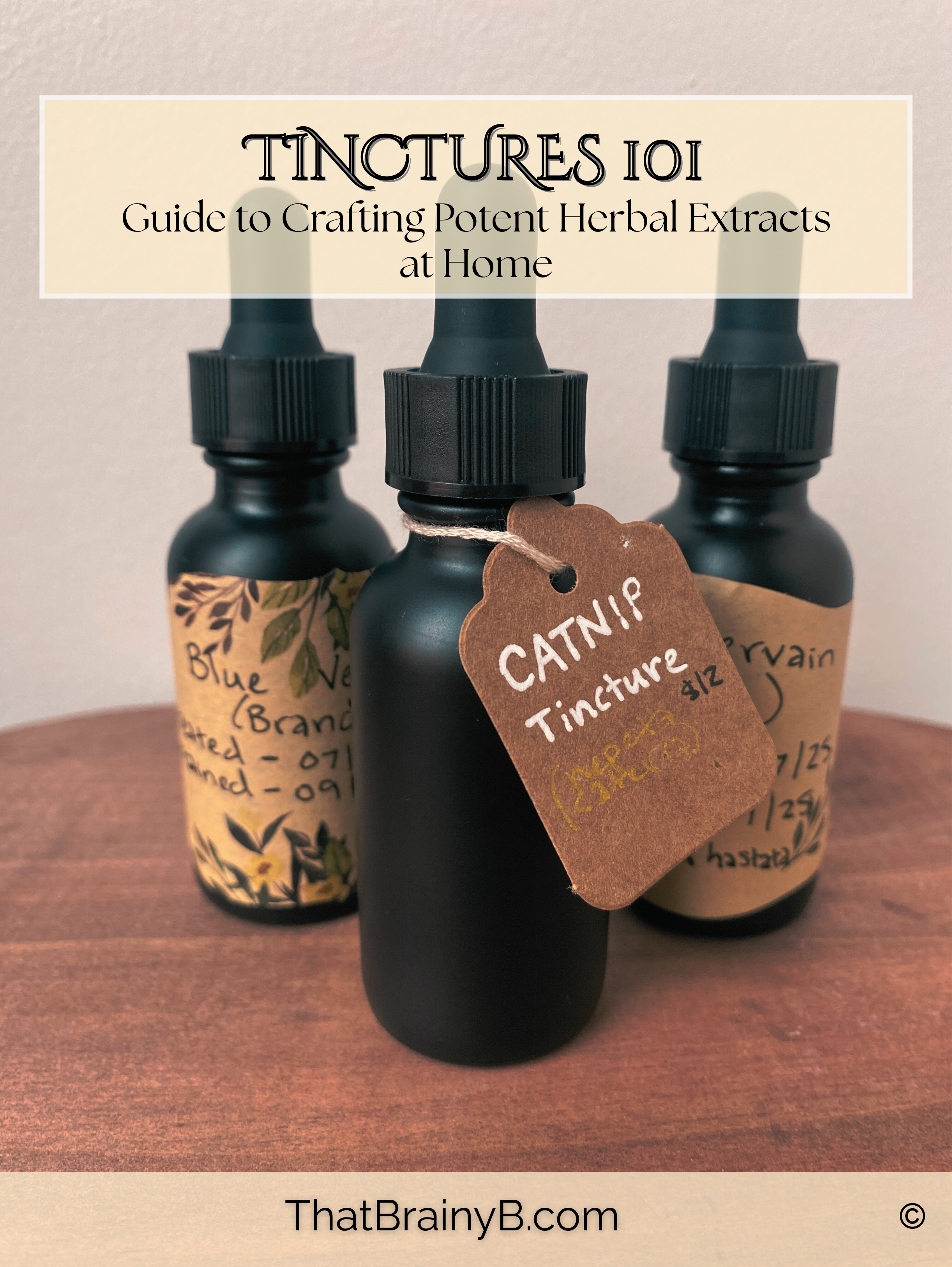
Tinctures have long been valued in traditional and modern herbalism for their convenience, potency, and shelf stability. As an interest in natural remedies continues to grow, understanding how to make and use tinctures safely is an empowering skill that we can beautifully pass down to our children. This can be especially useful for anyone seeking holistic approaches to wellness and care. This post offers a scientifically grounded overview of tinctures, their benefits, and a foundational method for creating them in the comfort of your home! Keep it simple with the basics, or read on for bonus tips and more complex extraction methods.
What is a Tincture Exactly?
A tincture is a concentrated liquid extract of constituents in alcohol. There are two main processes known as maceration and Percolation. Tinctures differ from teas or infusions in that they are much more shelf-stable and a little more portable with requiring only a few drops per use. Some may say they are often more bio-available and deliver well to the ears, gut/liver, mouth, reproductive organs, and Urinary Tract through digestion. For detailed step-by-step instruction on maceration and percolation see Sam Coffman’s Herbal Medic [linked here]. This book is a primary reference for tincture preparation and has strongly informed the general approaches shared here.
Maceration - Mixing with alcohol in a jar, and setting aside in a cool dark place. We will get into the maths later but this is simplest method of all. Let her sit for 2-4 weeks and then strain with your method of choice. The easiest method often referred to as the simpler method; is stuffing your jar with a fresh herb and then filling with your alcohol of choice. No need to dry, cut, or do anything with anything - only the fun parts so it can be a great activity for older kids if you allow. You could also optionally pulse or chop your plant material for a bit more potency. I did this for a cilantro and coriander tincture from my Book Ayurvedic Herbal Medicine for Beginners, read about an Ayurvedic Perspective. Feedback from my family friend was “This shit works Brit,” so we love that. The ratios (which we will chat more about in a bit) are typically 1:3 for something cut and dried and 1:5 for something powdered.
Percolation - This method is a bit tends to have a few more steps, but don’t let that overwhelm you. The result is a lovely high quality product that is crafted much quicker than if you were macerating. If you live the busy life, this might be your preferred route. This is done by slowly percolating alcohol through your dried herbs using a funnel. You would craft your funnel with a coffee filter, and place it in a bottle nice and snug. This is especially great for fresh or demulcent herbs that tend to clump together to encourage the filtration.
Also those active compounds we are extracting are actually substances that have a direct impact of living organisms, tissues, and or cells. Active compounds could include caffeine in coffee, Peptides, Pharmaceuticals, Pesticides, Herbicides, Phenol’s, Terpenes, Alkaloids, etc.
A Glycerite is actually considered a maceration tincture. This is made by using USP-grade glycerite which creates essential alcohol free tinctures ideal for children, those recovering, etc. You can purchase numerous high quality tinctures and glycerites through Mountain Rose Herbs.
* All recipes and ideas shared here are for educational and informational purposes. Every body is different, use what feels right for you and seek professional guidance when needed. Avoid these common mistakes. *
Lets Talk Alcohol Percentages
<Amounts are listed below in printable>
40% ABV = 40% alcohol and 60% water (60+40=100%) -> 80 proof.
Proof = Double the alcohol %
Sam Coffman wrote that he prefers 90-90% ABV for easy dilution.
Maths…?
* 1 ml of water = 1g
If you want a ratio of 1:4 and have a 30g of dried herbs, how many ml of water will you need?
120ml from 30 x 4 (4 from the ratio).
Lisa M. Rose shares in ‘Midwest Medicinal Plants: Identify, Harvest, and Use 109 Wild Herbs for Health and Wellness,’ that high-proof alcohol works best for plant resins while vinegar is better for extracting minerals. A great teacher especially if you’re learning from a Midwest plant perspective.

Welcome!
Hey, I’m Brit. I help you blend the comfort of the kitchen with the care of the apothecary.

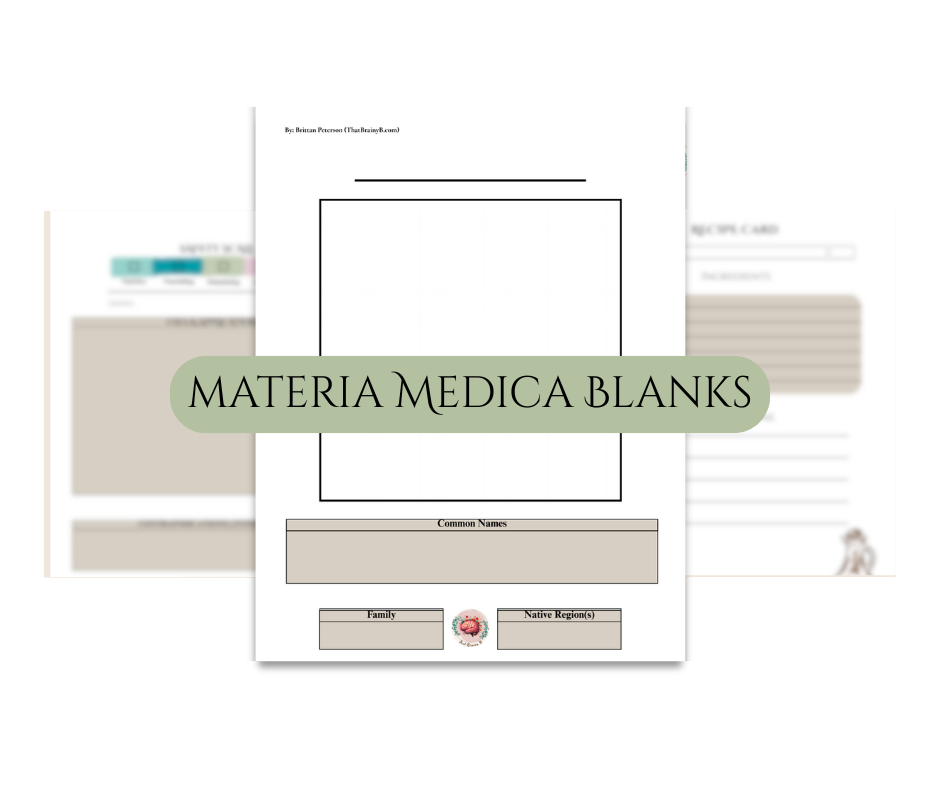
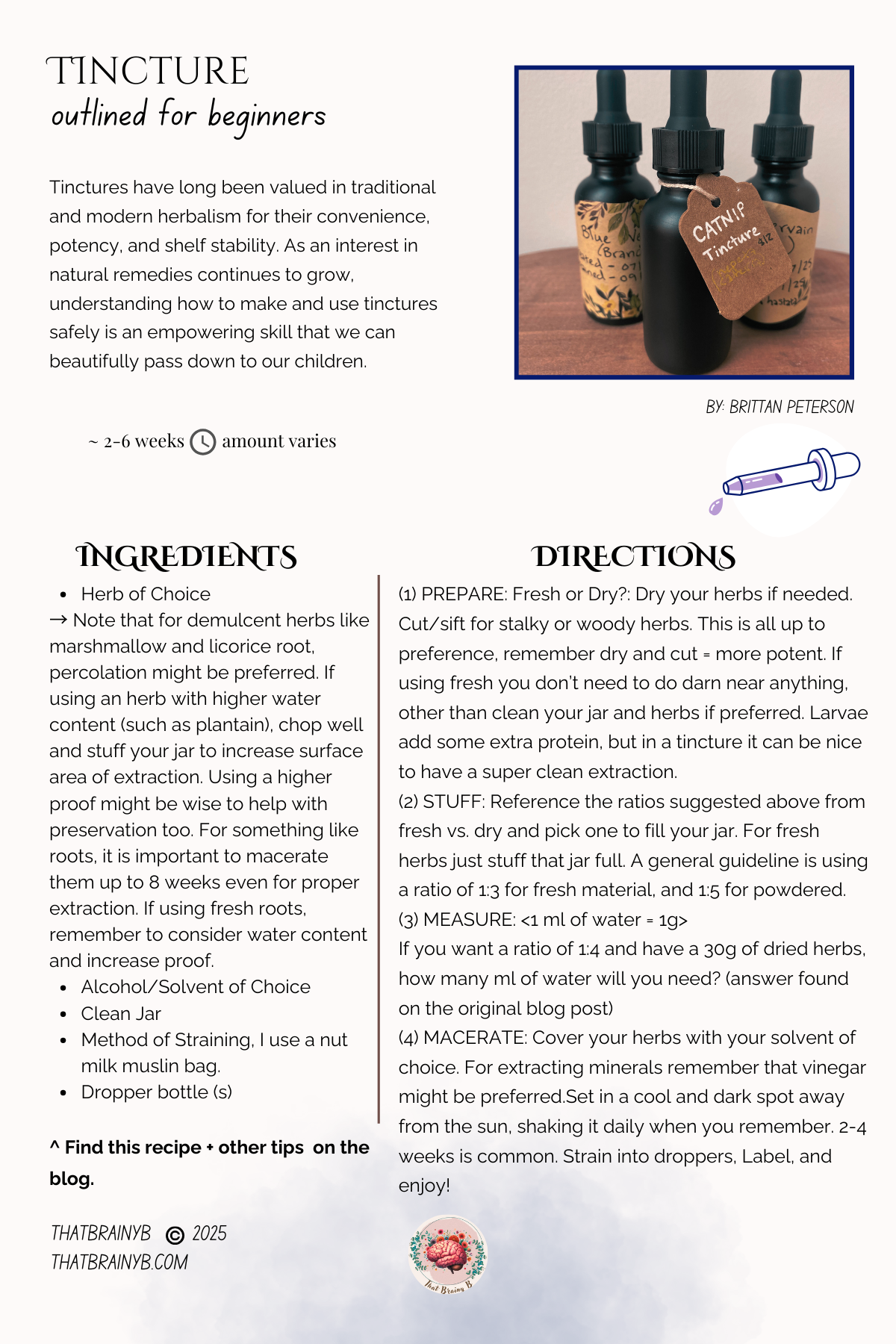
Fer Simpler’s Method You’ll need:
One herb of choice that can be used for variety of ailments. Think of motherwort for heart and anxiety, lavender, yarrow, and chamomile.
Alcohol/Solvent of Choice
Clean Jar and Cool/Dark Area.
Instructions
(1) Fresh or Dry?: Dry your herbs if needed. Cut and sift for stalky or woody herbs. This is all up to preference, remember dry and cut = more potent. If using fresh you don’t need to do darn near anything other than clean your jar and herbs if preferred. Larvae can add some extra protein but in a tincture it can be nice to have a super clean extraction.
(2) STUFF: Reference the ratios suggested above from fresh vs. dry and pick one to fill your jar. For fresh herbs just stuff that jar full.
(3) MACERATE: Cover your herbs with your solvent of choice. For extracting minerals remember that vinegar might be preferred.
(Check out this recipe). Set in a cool and dark spot away from the sun, shaking it daily when you remember. 2-4 weeks is common.
(4) STRAIN: Once your it has macerated, strain using your method of choice into a dropper style container. I really like using a method cheesecloth style bag so I can squeeze out all the product. Now you have a very shelf stable and portable tincture that will last for years.
Finally as my teacher Ashley Elanbass says, “don’t forget to label.”
For your First Recipe
<PAIRING N’ PICKIN TIPS>
Start with safe and gentle herbs, ideally that you know work well for you. I mentioned some suggestions above, and pair with other safe and gentle herbs that have a similar profile with slightly different personality.Get Ideas
BONUS: Multi-fractional Extract
Another more complex route of extraction using two or more methods of extraction to get more final product. This might also be preferred for certain herbs like Echinacea or mushrooms, or Demulcents. This can be confusing since there are many different ways you can do this, for a guideline Sam wrote he prefers to do Cold > Hot > Alcohol (95% ABV) > Glycerin to prevent precipitation. As mentioned before, certain herbs extract better in cold water like your demulcents. Some herbs don’t even really need hot water, but roots definitely do for a longer period of time (decoction). You could also use vinegar, honey, even wine here so I would suggest finding a multi-fractional recipe to reference for your first one and then venture on. As mentioned before all credit truly goes to Sam Coffman for the outlined methods. Questions regarding the more complex methods below should ideally be sent in his direction.
Instructions (Outlined)
(1) Do your first method of extracting. If you are doing a cold water infusion I would start there. Strain.
(2) COMBINE: Combine with glycerin which should be a minimum of 10-25% total your extraction (25-35% is even better) to help preserve.
(3) SIMMER: Add to a pan and mark before adding an extra 30% of total water volume to compensate for what will evaporate. Strain and set aside.
(4) SETUP: Setup a funnel with a paper cone filter and pack the strained herb from the cold water infusion into it. Pour alcohol into the funnel like you would do for the percolation method.
(5) COMBINE: Combine the tincture water infusion and decoction from the pan. Mix well and you have your final extract. The total alcohol volume % of the final extraction should be a minimum of 20% for preservation so I would consider that in your amounts.
Full credit for ALL of the above steps goes to Sam Coffman, reference from his book below.
Other Recipes & Resources
Sam Coffman Book → [Purchase Here] OR [Education Offered]
Diluting High-Proof Tinctures → [Read More]
Lisa Rose Book → [Purchase Here]
**VOTE ON EVENTS FOR 2026** → Vote Now
Trusted Source for Herbs & Tinctures → [Purchase Here] & [Apotheosis] < My local supplier and partner.
Find your Flavor FREE Workbook → [Get Freebie]
More on Ratios and Volume → [Read More]
This post contains affiliate links. If you click through and make a purchase, I may earn a small commission at no extra cost to you. I only recommend products I truly support and use or just really enjoy. Thank you so much for supporting my small business!